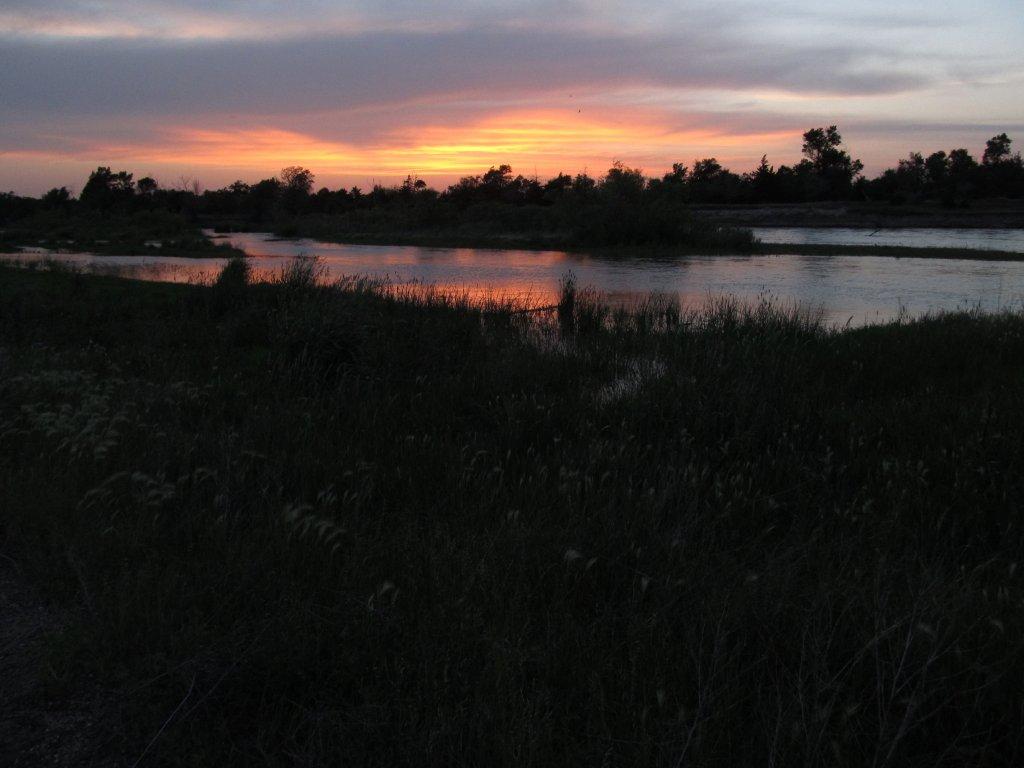
Sunday, June 12, 2011

Pony Express -- June 11 2011


Greetings,

June 11 2011 – Between Rush Creek Ranch and Mud Springs – Again I rode a half day, 25 miles.  The second half of the day was all roads and the first half had some very fine trail sections.  I rode with Tracy, Max, Gary, Janus, Dave, and another woman.  The trails were rolling prairie on the edge of the Sand Hills.  We use a GPS for trail so there were no ribbons and no tracks.  We rode across clean prairie.  The XP ride is very different from the structured format of a regular endurance ride and I really appreciate the easy-going attitude on the XP trail.  There are certainly some very competitive riders on the trip, but nearly everyone is only out for the adventure.  Nearly everyone shares the same goal – to get the horses to Virginia City healthy and sound.  I am traveling with a very competent group of horseman.

We are all sleep-deprived on this trip.  We leave on the trail at 5:00 am Mountain Time which means that we get up at about 3:30 in order to have enough time to eat breakfast, pack camp, and saddle a horse.  We are only getting about six or six-and-one-half hours of sleep each night.  The rest days are greatly appreciated and most people take the rest day to repair tack, fix trucks, or just sleep late and take life easy.

Because I rode the first half of the day, and because we started this morning at 5:00 am, Cindy and I had the time to take a slight detour to Alliance Nebraska to see Carhenge.  From Wikipedia:

"Carhenge consists of 38 automobiles arranged in a circle measuring about 29 metres (95 ft) in diameter.  Some are held upright in pits 1.5 metres (4.9 ft) deep, trunk end down, and arches have been formed by welding automobiles atop the supporting models.  The heelstone is a 1962 Cadillac.  Carhenge replicates Stonehenge's current "tumble-down" state, rather than the original stone circle erected between 2500 BC and 2000 BC.

"Carhenge was conceived in 1987 by Jim Reinders as a memorial to his father. While living in England, he studied the structure of Stonehenge, which helped him to copy the structure's shape, proportions, and size."

For someone who appreciates whimsical metal sculptures and art, Carhenge might be considered hallowed ground!

Tonight we are camped at site of the Mud Springs Pony Express Station.  Mud Springs was likely a Pony Express home station and was certainly a stop on the stage coach road.  Today we caught our first sighting of two prominent landmarks on the pioneer trails – Courthouse Rock and Jailhouse Rock.  Tomorrow, we may be able to see Chimney Rock and we are in Plains Indian country.

Best Regards,
Tom N


Pony Express June 9 2011


Greetings,

June 9, 2011 – Julesburg Colorado to Rush Creek Ranch Nebraska – Today we rode to the historic Rush Creek Ranch in SW Nebraska.  The Rush Creek Ranch is a large cattle and horse operation that dates from the late 1800s.  The ranch was acquired by a Chicago banking family when the bank repossessed some cattle.  After the repossession, the bank sent some family members to take ownership of the cattle.  The family members looked for some place to winter the cattle and the Rush Creek Ranch was formed on the south side of the North Platte River near Lisco Nebraska.  Today Rush Creek is one of the largest ranches in Nebraska and the ranch is known for its ranch-bred Arabian horses.   The ranch is so large that the ranch cowboys have traditionally used Arabian horses for the cattle work.  The horses that lack sufficient "cow sense" are sold and today the Rush Creek Arabians have well-deserved reputations as outstanding endurance horses.

On our way here, we stopped in Chattel Nebraska for some groceries.  Chattel seems to be a small, but enduring railroad and farming center on the Union Pacific main line.  The population of the town is under a thousand.  I ended up talking with Randy S who owns a local bar and restaurant as well as a construction business.  The bar is in an old bank and Randy mentioned that he would like to sell the bar business and that I could acquire the bar, restaurant, fully-furnished, fully stocked, and building for well under $100,000 – very different from Boise prices.  Cindy and I shared an omelet in a small but well-run restaurant just down the street, and then drove to the halfway point.

We both planned to ride the second twenty-five miles into camp and we arranged for a member of another crew to drive the van.   We saddled up in a light rain storm and left on the trail.  The first twelve miles were farm roads.  On the way, we met Michael W who is a certified organic farmer.  Michael farms about five sections and his neighbor, also an organic famer farms another four sections or so.  Together, they farm about 5,000 acres.  Michael grows wheat and other grains and he has contracts with Kellogg and Kashi foods.  His neighbor had planted peas and was plowing the peas into the soil to add nitrogen rather than using chemicals.

We then rode the trails into the Rush Creek Ranch.  The flat prairie gave way to a nice creek valley as we rode down into the North Platte drainage through the ranch holdings.  It was very good to be back on trails after  several weeks of riding on roads.  Along the way, we met a ranch cowboy who was very interested in my brand – the Rocking LT.  Brands are registered by state and it seems as if his wife owns the Nebraska Rocking LT.  It was an interesting coincidence that led to a nice conversation.

Cindy rode Frank and as usual, Frank was a pulling, rooting, head tossing son of a gun.  I rode Whiskey on a very light rein.  I never thought I would hear the words, but Cindy asked to ride Whiskey the next time.

Tonight we are camped in the cottonwoods along Rush Creek and the ride is taking a layover day tomorrow (Friday).

Best Regards,
Tom N


Thursday, June 9, 2011

Between Ogallala Nebraska and Julesburg Colorado - June 8 2011

Greetings,

June 8, 2011 – Ogallala Nebraska to Julesburg Colorado – Julesburg is the only Pony Express stop in Colorado.  The XP trail only travels across Colorado for a few miles and Julesburg was a trading post and military outpost in the 1860s.  Julesburg is named for the French trapper Jules Reni, and the Pony Express in Julesburg is best known for the feud between Jules Reni and Jack Slade.  Accounts of the feud differ, but the essence is that Jules Reni and Jack Slade had a disagreement and guns were used.  From the historical writings it appears as if Jack Slade was disagreeable in nature and after the initial confrontation, Jack Slade came back to Julesburg and killed Reni.  Eventually, Jack Slade met his end in the loop of a hanging rope in the Montana gold camp of Virginia City.  Today, Julesburg is a farming, ranching, and railroad community.  Julesburg still serves as a way stop on Interstate 76 between SW Nebraska and Denver.

We rode in across the farmland of SW Nebraska.  The weather was cool, breezy, and pleasant.  The air is dry and I feel more at home.  We are near the Front Range of Colorado.

Cindy and I stopped at a truck stop in SW Nebraska and I looked at a US highway map mounted on the wall.  We have come a long way since we stood on the bank of the Missouri River a few weeks ago.  Even though I am generally riding shorter distances than the full 50 miles, I think my strategy is valid.  Many people's horses are footsore from the roads.  I think that my horses could go indefinitely at distances from 25 to 40 miles per day around five days per week.  I still have two sound horses and a good crew.  Others have not fared as well.  The Nebraska roads have been tough.


Best Regards,

Tom N

Tuesday, June 7, 2011

Near Roscoe Nebraska


Greetings,
June 7, 2011 – Between Lake Maloney to near Roscoe Nebraska – Today we left Lake Maloney along the Nebraska Public Power District's Sutherland Canal.  It was a beautiful breezy cool morning that gave way to a sunny and warm afternoon.  Riding along the canal was pleasant and we had the halfway stop near the NPPD Gerald Gentleman power station.  The Gentleman station is the largest coal-fired plant in Nebraska and generates almost 1400 MW out of two units.
A story about our trip was published in the Superior Nebraska paper after the end of our first week of riding:
_________________________
Riders retracing Pony Express Trail
More than 30 combination horse trailer and camper rigs rolled into Oak Saturday afternoon in advance of the arrival of a group of riders retracing the Pony Express trail. Before all arrived for the night, the weekend population of the northeastern Nuckolls County town would be more than doubled. Vehicle tags indicated the rigs were from various states including Virginia, California, Missouri, Wyoming, North Carolina, Nevada, Alaska and even Australia.
Saturday was their fifth day on the trail and animals and riders were becoming used to the routine. In addition to the mounts, riders and crew, most of the rigs also contained dogs. The owners didn't say but the vigilant dogs have a vital role to play in such excursions. The dogs are often the first to notice something is amiss and alert their owners to a potential emergency. Each unit represented a rider with one of more horses or mules, the support crew and the related tack, hay, grain, housing, food and supplies for both people and animals.
The ride started near St. Joseph, Mo. Riders expect to travel 50 miles, five days each week for the next eight to 10 weeks or at about the speed the cavalry rode when white folks settled the plains.
But not all riders expect to ride the entire distance. Some ride on selected days, others only half a day. A woman from Wyoming who has been participating in such rides since the 1970s said it is her goal to ride the full 50 miles each day. A man from California said he would leave the ride for two weeks to attend to business and then return for the finish. A 71-year-old man said he was riding about one day a week. Riders range in age from 15 to 71.
The event is sanctioned by the AERC (American Endurance Ride Conference) which was founded in 1972 as a national governing body for long distance riding. In addition to promoting the sport of endurance riding, the AERC encourages the use, protection and development of trails, especially those with historic significance such as the Pony Express Trail.
David Nicholson, the ride coordinator, is a semi - retired veterinarian from Alaska. A club started in 1976 was an outgrowth of the Great American Horse Race which went from New York to California.
"I was in-between jobs and part of a trail ride that fell apart in Hannibal, Mo. In 1976, during the bicentennial year, a small group of endurance riders set out from St. Joseph in an attempt to ride to Sacramento on the original Pony Express trail. At that time there were no maps of the original route.
"We could not find much about specific trail routes. Mom had Sir Richard Burton's book, 'On the Road to the City of Saints.' With 15 riders we rode as far as we could figure out the trail and then would stop and study until we could move on.
"Two years later (1975?), a trail map was published. It was a great help," he said.
"In 1979, the British post office sponsored a second endurance ride over the historic Pony Express trail to commemorate the 100th anniversary of the death of Sir Roland Hill, the inventor of the modern postage stamp. So we did it again.
"However, at times there have been attempts by the Federal government to destroy the trail, especially between Salt Lake and Carlson City. Dessert entry points where plowed and graded. In the 1970s, it was decided one of the best ways to preserve the historic trails was to ride the trails with horses. So for a number of years, we organized five-day endurance rides along the Pony Express trail in Utah and Nevada. The club grew and in 2001, riders wanted to ride once again all the way from St. Joseph to Virginia City.
"Most riders join because they want to see the country," Nicholson continued.
Endurance riding is a sport. People interested learn about the ride through horse related magazines.
To participate in endurance competition a horse must be at least five years old.
"There are several 5,000 mile horses on this ride and a 10,000 mile horse or two," Nicholson said.
Younger horses in training are considered to be ducks. Some days they are ridden till lunch and other days after lunch, but not all 50 miles. On this ride veterinarians check the health of the horses at least twice a day. The tests including monitoring and recording temperatures. The riders are on their own.
Most of the horses used for endurance riding have Arabian bloodlines. The Arabian was bred to be a war horse. They are lightly muscles with big circulatory systems - built like marathon runners versus the quarter horse which is build like a weight lifter. Training makes up for lots, so there are other breeds represented.
A major source of the horses for endurance riding are rejects from the Rush Creek Land and Cattle Company. The ranch management doesn't let many go, only ones that aren't cowy (ones without good cow sense). Because the ranch is so large, they host ranch trials, which were a forerunner of the endurance ride.
As one travels west, endurance riding becomes more common. There is more varied terrain and people find endurance riding as a great way to see places.
AERC establishes a point system for weigh division. Best conditioned horses earn the most important awards: the first horse across the finish line in condition to go on as determine by a set of criteria which include heart rate recovery time and lameness. The sport is controlled by veterinarians. Points are totally daily but one of the long term riders said it is more of a personal competition and not a group contest. Riders set their own goals and then used the points to measure their accomplishment.
Two Express reporters were present for the Saturday evening trail meeting. At that meeting participants compared notes and made plans for the next day.
Before starting out the rider manager distributed GPS coordinates for the day, but the riders said their GPS systems didn't work in the heavy rains encountered on the first part of the ride. Many had to rely on printed maps and some became lost. Detours were taken when the planned trail became muddy and the horses couldn't get traction. Rig drivers became stuck and had to be towed. At least one bridge was washed out causing the riders to seek an alternative route.
One participant reported he became concerned when his wife was late in reaching camp. He set out with their pickup and trailer hoping to locate her. He was following her GPS signal when the road became impassable. Stuck he was wondering what to do next when his wife rode up. With her help, they unloaded their horses and the truck with a lighter load was able to make it back to a better road.
Another rider commented having a stiff neck for two days and riding hunched over in the downpour.
Most riders carry rain gear but they said it didn't do much good in Tuesday's downpour. One said she also carried both people and horse food and a sponge. Why a sponge? To air conditioned her horse. Without dismounting the rider lowers the rope equipped sponge to a mud puddle, collects the cooling water and then sponges down her horse.
Often a rider's spouse serves as crew. In some cases two people were taking turns riding and crewing. In other cases the rider had a hired crew. Crew members are responsible for moving the support vehicles and often run errands and arrange for feed and other supplies.
Saturday many of the crew members came to Superior and participated in part of the festival. Sunday and Monday more returned to buy supplies and visit the Nuckolls County Museum. Most we talked with reported they wanted to investigate the history of the areas they would pass through.
Four participants, two men with the wives, are from Australia. They had purchased their horses and rigs after coming to the United States and planned to ship the trailer home once the ride is finished.
At Saturday's trail meeting it was reported the ride had covered 250 miles and eight people had ridden the entire way.
____________________

Best Regards,
Tom N


Monday, June 6, 2011

Rest Day - Lake Maloney Nebraska

Greetings,


June 5 and 6, 2011 – Rest Day – Lake Maloney Nebraska – Our gypsy caravan is starting to form into a cohesive group.  The two weeks on the trail have helped everyone appreciate just how far it is to California.  Some riders and crews are feeling the stress and some will probably not last.  Horses are footsore from traveling on hard Nebraska roads.  Many vehicles have been stuck in the mud on various farm roads.  However, nearly everyone remains optimistic and helpful and we are working together to make some major truck repairs, horse treatments, re-shoe horses, along with general camp and trail duties.  Two guys worked all day Sunday to repair an oil cooler on a diesel truck.  The lead mechanic is a Ford Mater Mechanic so the truck is in very good hands.  Dave Nicholson, the trip leader, has a trailer with a very complete set of tools including a welder, drill press, and other metal fabrication machines.  Other riders have various wrenches, drills, and other hand tools and they freely loan those tools to others.  Our group is really quite self-sufficient.  When something breaks, the trip continues while the owner of the broken device calls and finds replacement parts in the nearby towns.  If the parts cannot be found locally, then the parts are sent by overnight delivery to some waypoint along the trail.  The repairs are made and the rider rejoins the caravan.

Today, Monday, we enjoyed an XP pancake breakfast.  Earlier in the week someone from the trip was in a small town and one of the local residents inquired about the trip.  After he heard about our excursion along the Pony Express Trail, he gave us ten bags of his gourmet pancake mix.  Today, we cooked the pancakes, along with bacon, sausage, ham, eggs, watermelon, strawberries, coffee, and other foods for a group breakfast.  After breakfast it was back to camp chores such as truck repair, securing hay, and other less strenuous activities like feeding the local geese.

There are a people from all backgrounds on the trip -- people who are quite well-off to some true gypsies.  What everyone has in common is the commitment to get this band of horses and riders to Virginia City. 

After two weeks, I have adjusted to the life and the schedule.  We wake at 4:30 am, tend to the horses, eat breakfast, pack the van, and around 6:00 in the morning, head out on the day's trail.  In the afternoon, we work together to set up camp, tend to the horses, eat dinner, walk the horses, and go to bed.  It is a simple life and it is a good life.

Near us in the campground are two "gentlemen" who are permanent residents and who have lived in the two school busses and associated travel trailer for over twenty years.  Those two have lived in this campground in summer and winter through seven different owners.  Their section of the campground has a sign that reads, "Outlaw Corner, Enter At Own Risk."  The two talked about the Nebraska winters and talked how the winds and temperatures can be difficult but they remain here at the Lake House Campground and fish in the summer and they probably play cards and such in the winter.  While I am glad that not everyone in America chooses their lifestyle, I am glad that our society is tolerant enough to allow these old men to pursue their alternative lifestyle, fish, and feed the birds and squirrels.  Just as I am happy that our band of 30 or so riders, another 50 or 60 family members and crew, and about 100 horses can travel across the Western US and be welcome.  Not many people have experience with farm animals in the 21st century and we and our horses are ambassadors on the trail.  On Saturday in North Platte, several families with children came up to the trailer to visit with Frank and Whiskey.  When they ask where we are going, and we answer, "California, on horseback along the Pony Express Trail", we receive various replies.  However, after a short discussion, nearly everyone remarks that we are on an amazing adventure.  Many are envious.   Cindy and I are enjoying our life on this gypsy caravan and we are very lucky to have these experiences.


Best Regards from the Pony Express Trail,

Tom N


The Pony Express -- June 3,4 2011

Greetings:
June 3, 2001 – Fort Kearney to Near Gothenburg (Hiles Canyon) – Today I rode Frank the full 50 miles.  We started early and passed the Nebraska Public Power Canady Steam Plant.  Idaho Power has been very generous in allowing me to take the time for this trip and I like to comment on the various electric facilities that I pass on the trail.  The Canady plant is a natural gas steam boiler unit that generates about 100 MW of power.  The plant was built in 1958 and modern combined-cycle combustion turbine plants are more efficient.  The Canady plant is used to meet peak demand.
We camped at Hiles Canyon in Southern Nebraska.  We were camped along a very large irrigation canal built as part of a WPA project in the 1930s.  Many of us took the opportunity to jump off a concrete weir into the canal and then floated as a group downstream past camp.  The float was very pleasant.

Best Regards,
Tom N

June 4, 2011 – Hiles Canyon to North Platte Nebraska – Again today, I took Whiskey out for a half day.  We rode along the canal banks and on farm roads.  Tonight we are camped at a very nice family-owned campground on the shores of Lake Maloney.
I want to comment on some of the difficulties that we experience on a cross-country, point-to-point endurance ride.  Two days ago, on Thursday evening, Whiskey broke his HiTie.  The HiTie is a swing-out fiberglass arm that is used to tie a horse to the trailer.  I have had the HiTies on this trailer for six or seven years.  I called EasyCare on Thursday night after hours.  On Friday, EasyCare sent a new HiTie to me via overnight express.  Today, Saturday, the HiTie was waiting when we arrived at the campground.  And now, Saturday afternoon, the replacement HiTie is installed.  The EasyCare customer service is outstanding.  The company understands, and supports, long-distance riding.
We'll take two rest days here at Lake Maloney.  There is a bar and grill restaurant as part of the campground and I am sure that our gypsy caravan will overwhelm the bar and grill tonight just as we did a week ago on Oak.  It should be a lively evening on the shores of Lake Maloney.
At the end of week two, Frank has run five days and 150 miles while Whiskey has run five days and 125 miles.  Whiskey is strong and I plan to save Whiskey to three days per week and ride Frank only two days per week.  We should be in Nebraska for another week or so and then on to Wyoming.  When the trails change from hard-packed roads to two-track trails, I'll move both horses up to fifty-mile days.


Thursday, June 2, 2011

On the Pony Express Trail


Greetings,

June 1, 2011 – Between Hastings and Fort Kearney, Nebraska -- Not too much to write about today.  The roads were straight and Frank and I headed west to Fort Kearney.  We met several local residents who talked to us about the history of the area.  Our traveling gypsy caravan seems to attract attention wherever we go.  People want to stop and talk.  When they hear about the starting point and the destination, the talk usually gets more interesting.  Today I talked at length with a local farmer who works about 3,000 acres.  These farms are big operations.

June 2, 2011 – Between Fort Kearney and near Lexington, Nebraska – Tonight we are camped on the banks of the Platte River.  Last night we had another series of wild electric storms.  The storms are far more exciting than the minor thunderstorms that we get in Idaho.  Throughout the night, the lightning was nearly constant and the wind blew the rain against the trailer.  The field where we camped became muddy and a few rigs became stuck.  We drove out without difficulty, perhaps because we did not load the horses until we reached pavement.
The roads are still straight.  I decided to ride the afternoon section because we will follow some canal banks and have a few more turns.  The footing on the canal banks was wonderful and Whiskey appreciated the canal bank roads.  It was nice to not be following the section-line grid going west and north.
One thing that is hard to miss is the depth of economic depression in some of these small towns.  In one town in Nebraska, we heard that a person could purchase a home in town for one-thousand dollars.  Thirty-five hundred dollars recently bought a very nice house in that town.  It is difficult for me to imagine a nice Idaho house selling for even ten thousand dollars.
Even with those prices, and several abandoned buildings in the town, the local townspeople still have pride in their community.  It seems as if all the lawns are clean and mowed, even the lawns of the abandoned houses.  Each resident must mow several lawns, even though their neighbors are gone.  The sense of community in these small farming towns must be very strong.
There was a memorable town in Kansas where most of the store fronts were boarded up and shuttered.  There was only one prospering business in that town – a bank.  It seems as the bank was very affluent and constructed a new brick building in period architecture.  The money for the bank construction came out of the pockets of the people in that town and that county.  I work for a heavily regulated business that manages to make a positive return for its shareholders and provide reliable electric service at sensible prices.  Idaho Power does not have the money or the culture to construct palatial buildings and extravagant facilities in depressed communities.  It certainly seems to me that the banks in the US could use considerably more regulatory oversight -- especially with the paltry returns that the banks are presently paying on customer accounts.  It appears as if some bankers are becoming far too wealthy in some very desperate communities.  Sensing the stark differences in these communities between those that have and those who are just hanging on to any sort of livelihood, I can understand and sympathize with the populist heritage of the farm country.  Woody Guthrie and John Steinbeck would have a lot to write about today in the farm country of Nebraska.

Best Regards,
Tom N